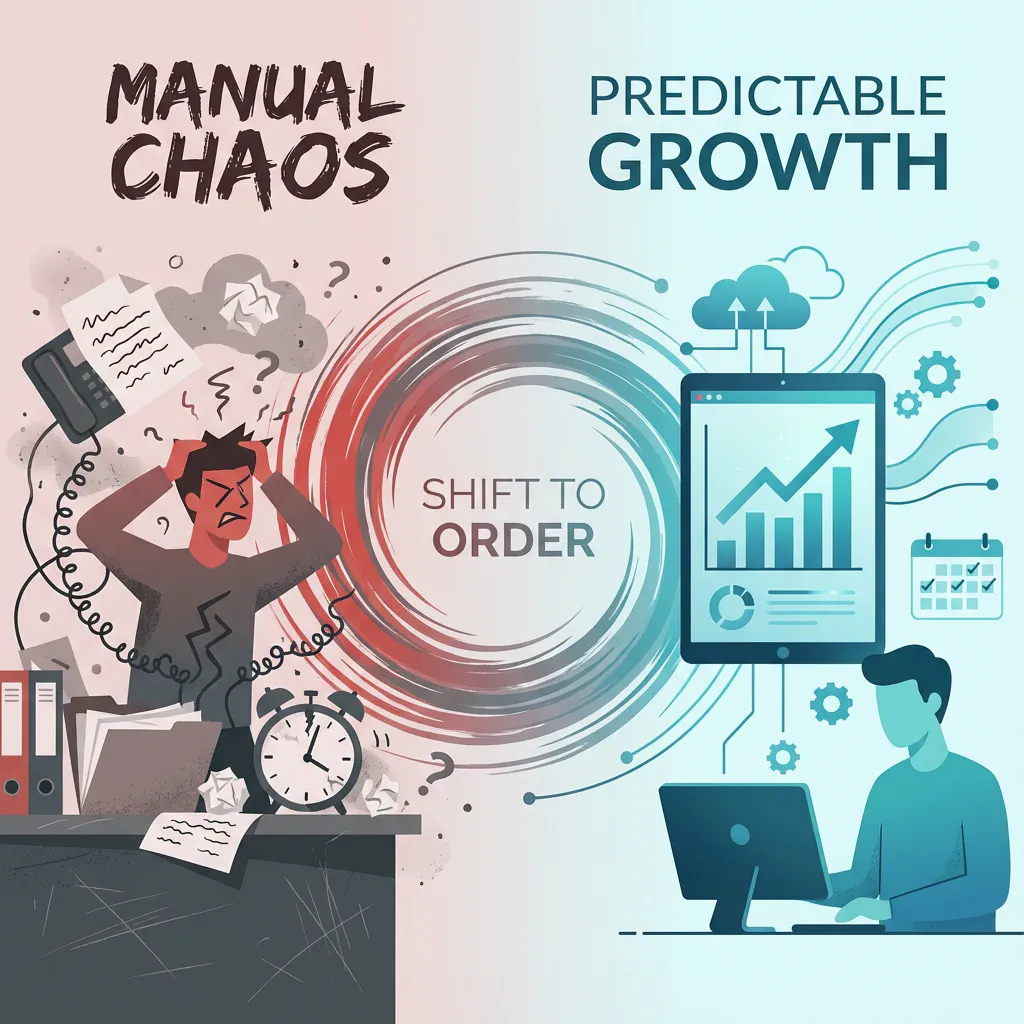
Theme: Order → Efficiency → Scale
Walk through a typical day for many brands today.
WhatsApp is blowing up with “Is this available?”, “Send options”, “What’s my order status?” Your staff is flipping between screenshots, old chats, and half-updated Excel sheets. Your POS shows one number for stock. The godown team says something else. Marketplaces show “out of stock” on products that are literally sitting in cartons in your back room.
By evening, you’re exhausted. Not from selling, but from managing chaos:
- Orders scattered across WhatsApp, marketplaces, and walk-ins
- Stock figures nobody fully trusts
- Delayed dispatches because someone missed a message
- Billing mistakes that lead to refunds, discounts, and apologies
This is how many early-stage and growing brands are still operating in 2025.
The problem isn’t effort. The problem is system design. To survive and grow beyond 2026, brands will have to make one non-negotiable shift: Move from manual chaos to intelligent systems that create Order → Efficiency → Scale.
The Reality Today: Manual Chaos Disguised as “Hustle”
Most brands don’t start chaotic. They become chaotic as channels, products, and orders grow. Here’s what “manual chaos” looks like in real life.
1. WhatsApp Confusion as a “System”
For a lot of brands—especially in fashion, food, beauty, and local retail—WhatsApp has become the default storefront and CRM:
- Customers place orders in chats.
- Staff manually notes items and totals.
- Screenshots are forwarded to packers.
- Payment screenshots are forwarded back as “proof”.
One missed message = one lost or delayed order. It feels “personal” and “flexible”. But at scale, it’s:
- Unsearchable
- Hard to track
- Impossible to analyse
There is no real order management system—just chat history.
2. Scattered Stock and Guesswork Inventory
Inventory is often spread across:
- Store shelves
- Godowns/warehouses
- Marketplace stock
- Consignment stock
- “Reserved” orders on WhatsApp and DMs
But the systems tracking this are:
- POS software that’s not linked to online sales
- Excel sheets nobody has time to update daily
- Staff memory (“I think we have 3 left in the back.”)
This leads to:
- Overselling and cancellations
- Dead stock lying unseen in one location
- Stock-outs on high-demand items because replenishment is reactive, not planned
Without inventory management software or a unified retail ERP, brands are flying blind.
3. Slow, Error-Prone Fulfilment
Because orders come in from everywhere and nothing is properly connected:
- The team sorts orders manually each morning.
- Dispatch lists are handwritten or manually compiled from multiple sources.
- Wrong items get packed because catalogue references are inconsistent.
- COD orders get delayed because verification is manual.
This bottleneck is not because people are lazy. It’s because there’s no intelligent order management system powering fulfilment.
4. Billing and Payments Running on Patchwork
Billing in many growing brands is split:
- One format in-store
- Another format online
- Invoices manually created for B2B or bulk orders
- GST treatment handled by “that one person who knows Tally”
Payments are handled via:
- UPI QR codes that aren’t mapped outlet-wise
- Payment links manually sent on WhatsApp
- Marketplaces settlement in a separate panel
- COD settlement tracked in yet another sheet
The result: No single view of revenue, collections, and profitability across channels.
The Cost of Staying in Manual Mode
The problem with this manual, scattered way of working isn’t just stress. It has direct business impact.
1. Lost Revenue and Broken Trust
- Orders get missed in WhatsApp and DMs.
- Cancellations rise because of out-of-stock issues.
- Customers get different answers from different team members.
- Slow fulfilment kills repeat purchase potential.
In digital commerce, trust is built on speed, clarity, and consistency. Manual chaos breaks all three.
2. High Operational Cost Hidden Behind “We’re Managing”
Because everything is handled manually:
- You need more people to handle the same order volume.
- Senior staff end up doing basic coordination instead of growth work.
- Training new team members takes longer because processes are undocumented and informal.
Your cost per order silently goes up—even if you’re not measuring it.
3. No Real Data, Only Opinions
Without integrated systems, you cannot reliably answer:
- Which products are truly bestsellers across all locations and channels?
- Which customers are most profitable and most loyal?
- Which promotion actually increased net profit, not just top-line revenue?
- Where are you losing the most money—returns, discounts, shipping, or stock-outs?
You’re making strategic decisions based on gut feeling and partial reports, not on full-funnel, unified data. That’s dangerous in a market where your competitors are using digital commerce analytics, POS data, and inventory management dashboards to drive decisions.
The Shift: Order → Efficiency → Scale
The brands that will win the next three years are the ones that commit to a simple sequence: Order → Efficiency → Scale
Put things in order → make them efficient → then scale. This isn’t just about “going digital”. It’s about building intelligent systems that replace improvisation with predictable, repeatable workflows. Let’s break it down.
Stage 1: ORDER – Create One Source of Truth
The foundation of predictable growth is order. Not perfection. Not “big ERP”. Just clear, unified structure.
1. Structured Catalogue and SKUs
Move from vague product descriptions in chats to a structured digital catalogue:
- Every product has a unique ID / SKU.
- Variants are clearly defined (size, colour, weight, flavour).
- Prices and tax rules are standardised.
- Product data is stored centrally (not just in marketplace panels).
This is the heart of catalogue intelligence—the same concept that powers advanced retail systems and modern POS platforms.
2. Centralised Inventory Management
Instead of tracking stock in WhatsApp and memory:
- Use QuicShop to manage inventory across all locations.
- Map incoming stock, transfers, and sales to structured SKUs.
- Sync online orders and POS sales to the same inventory.
This gives you:
- Real-time visibility
- Fewer stock-outs
- Fewer overselling incidents
3. Unified Customer & Order Records
Every order—whether from:
- Website
- Marketplace
- Walk-in store
…should ultimately land in one system. This becomes your order nerve centre:
- Easier fulfilment
- Easier support
- Easier reporting
Now you have order-level clarity instead of scattered screenshots.
Stage 2: EFFICIENCY – Replace Manual Work with Intelligent Workflows
Once you have order and structure, you can unlock efficiency. Efficiency doesn’t mean working harder. It means your systems work for you.
1. Smart Order Management and Fulfilment
With a central system:
- Orders can be auto-assigned to the right location or warehouse.
- Pick lists can be auto-generated based on stock and priority.
- Status updates (packed, shipped, delivered) can be pushed automatically to customers.
- COD workflows (verification, reminders, RTO tagging) can be standardised.
This is where order management software and retail automation tools start paying off.
2. Consistent Billing Across Channels
Link your catalogue and inventory to billing and POS systems:
- The same product names appear on shelves, invoices, and online.
- GST rules, discounts, and pricing logic are consistent.
- B2B invoices, retail bills, and online invoices pull from the same master data.
Customers experience professionalism. You experience fewer manual corrections and GST headaches.
3. Automated Payments and Reconciliation
Integrate payment systems properly:
- UPI, cards, wallets, and BNPL routed through a single layer.
- Collections automatically tagged to orders and outlets.
- Settlements from marketplaces reconciled against your order records.
Finance teams stop chasing screenshots. Founders get a real-time view of cash flow and collections.
4. Systemised Selling
With your systems connected, you can now:
- Set up standard offers (bundles, combos, add-ons) linked to SKUs.
- Auto-trigger upsell prompts at billing and checkout.
- Standardise discount policies per channel and outlet.
Suddenly, your brand stops relying on “who’s on shift today” and starts relying on designed workflows.

Stop manual inventory updates today
Get real-time visibility across all your locations and channels with QuicShop.
Explore Inventory FeaturesStage 3: SCALE – Grow Without Breaking Your Systems
When Order + Efficiency are in place, scale stops being scary. You’re no longer asking, “Can our team handle it?” You’re asking, “Can our systems handle it?”—and the answer is yes.
1. Multi-Location, Same Playbook
You can:
- Open new outlets that plug into the same catalogue, inventory, and billing system.
- Give franchisees a standard operating model instead of letting everyone improvise.
- Maintain visibility on stock and sales across all locations in one dashboard.
That’s how multi-location brands grow without losing control.
2. Multi-Channel, One Brand Experience
Whether a customer buys:
- In-store
- On your website
- Via WhatsApp
- On a marketplace
…they see:
- The same product information
- Aligned pricing (or clearly defined differences)
- Reliable availability
- Consistent post-purchase experience
That’s what omnichannel retail should feel like—and it only happens when your systems are integrated.
3. Data-Driven Decisions Instead of Guesswork
With intelligent systems:
- Bestsellers are clear by category, region, and channel.
- Non-performing SKUs are visible, not hidden in stock rooms.
- Repeat purchase patterns and customer cohorts emerge in your data.
- You can forecast demand instead of reacting to stock-outs.
Now you can ask—and answer—questions like:
- “Which 20% of products drive 80% of our margin?”
- “Which city should we open in next?”
- “Which campaigns improved profit, not just revenue?”
This is what predictable growth looks like.
Before vs After: A Simple Narrative
Before (2024–Early 2025)
- WhatsApp is your order system.
- Excel is your inventory system.
- POS is isolated in-store.
- Marketplaces are managed in separate dashboards.
- Billing, payments, and stock reconciliation are manually coordinated.
- Every spike in orders feels like a fire to fight.
After (End of 2025, Entering 2026)
- One structured catalogue powers all channels.
- One inventory system tracks stock across locations.
- One order management layer unifies WhatsApp, website, marketplace, and walk-ins.
- Billing, tax, and payments are consistent and connected.
- Staff follow systemised workflows instead of inventing processes daily.
- Growth in orders feels like something to celebrate, not fear.
That’s not a “nice-to-have” digital transformation story. It’s a survival strategy.
Why This Shift Can’t Wait Beyond 2026
Customers are getting used to:
- Same-day or next-day fulfilment
- Real-time order tracking
- Reliable stock visibility
- Seamless UPI/card/BNPL experiences
They don’t care if you’re a local brand or a national brand. Their expectations are shaped by the best players in the market.
By 2026:
- Brands that stay in manual chaos will be stuck firefighting.
- Brands that invest in intelligent systems will move into predictable, compounding growth.
The difference will not be product alone. It will be Order → Efficiency → Scale baked into how the business runs.
If your current reality is WhatsApp confusion, scattered stock, and slow fulfilment, the signal is clear: It’s time to stop stretching manual systems. It’s time to build the intelligent backbone that turns your brand from a daily struggle into a predictable, scalable operation—before 2026 makes the gap impossible to ignore.