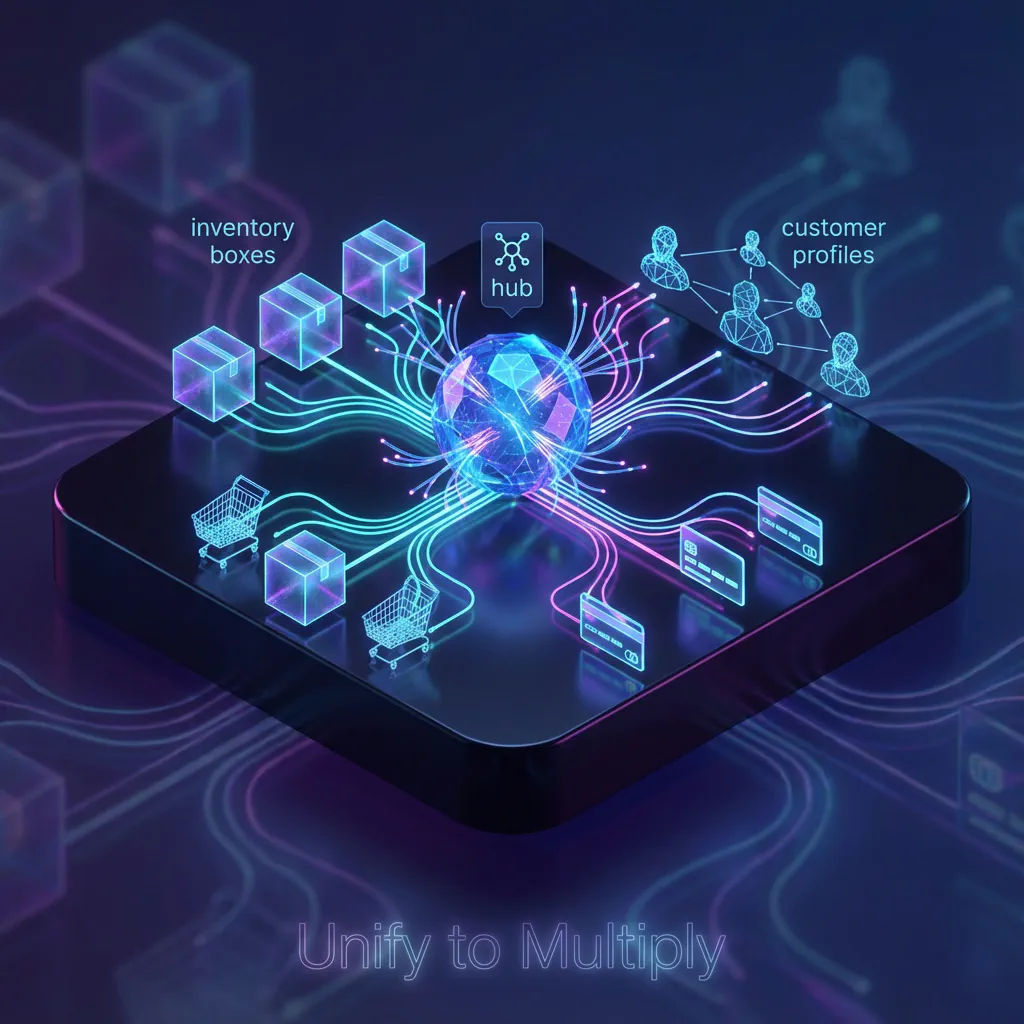
Theme: Unify to Multiply
You probably know this day. The website pings you with pending orders. Instagram DMs are full of “Is this available?” messages. Your WhatsApp is a mix of supplier updates, customer complaints, and screenshots your team forwards because “the tool doesn’t show this.”
Your POS says there are 3 pieces left. Your Excel sheet says 7. Your marketplace panel says “Out of stock.”
And by the end of the day, you are not building a brand. You are babysitting broken systems.
This is the real cost of running a modern brand on a pile of plugins, manual catalogues, and disconnected tools. On the surface, it looks “manageable”. In reality, it’s quietly taxing your growth, your margins, and your brand trust.
This is why modern brands need a connected operating system – a single nervous system that runs your catalogues, orders, customers, inventory, payments, and communication in one place.
The Hidden Tax of Fragmented Tools on Modern Brands
Most fast-growing brands don’t wake up one day and decide, “Let’s build a mess.” The mess happens in stages:
- You start with a basic e-commerce platform.
- Add a plugin for COD verification.
- Another for email marketing.
- A separate POS for offline stores.
- Google Sheets or Excel for wholesale and cataloging.
- A WhatsApp catalogue because customers “prefer it”.
- A marketplace backend with its own inventory logic.
Individually, none of these decisions is wrong. Together, they become a fragmented brand stack. Here’s how that fragmentation quietly hurts you.
1. Time: The Most Expensive Cost You’re Not Measuring
Every time your team jumps between dashboards, exports CSVs, or reconciles data manually, you’re paying a hidden time tax.
- Manually syncing inventory between POS, website, and marketplaces.
- Checking three tools to answer one customer query: “Where is my order?”
- Copy-pasting product details from Excel to website to marketplace listings.
- Aligning discounts and offers across channels so nothing contradicts.
This is time not spent on:
- New product development
- Better storytelling
- Creating content
- Building community
- Negotiating better deals with suppliers
Fragmented tools steal deep work and replace it with busy work.
2. Money: Subscriptions, Double Work, and Expensive Mistakes
On paper, every tool looks cheap – ₹999 here, ₹1999 there. But the real financial cost of fragmentation is much deeper:
- Duplicate subscriptions: Paying for overlapping tools because “migration feels painful.”
- Agency and tech hours: Burning money trying to integrate tools that were never designed to talk to each other properly.
- Errors that cost real revenue: Wrong prices, expired coupon codes still active on one channel, “Out of stock” on one platform while you’re fully stocked in-store.
One misconfigured plugin can wipe out the margin from an entire campaign. One mistake in inventory sync can trigger returns, refunds, and negative reviews that hurt your brand long after the month’s P&L closes.
3. Brand Trust: When Your Systems Make You Look Unreliable
This is the most dangerous cost – and the hardest to claw back. Fragmented tools create fragmented customer experiences:
- A customer sees a product in stock on Instagram, but the website shows “unavailable.”
- They get three different order status messages from three different systems.
- Your support team promises a timeline, but logistics data from another tool contradicts it.
- In-store staff has no idea what offers are running online.
Customers don’t see your stack. They only see inconsistency. Inconsistency looks like:
- You don’t know your own inventory.
- You don’t value their time.
- You don’t run a professional operation.
Once that trust cracks, every future conversion becomes harder. Your ad spends go up. Your organic word-of-mouth goes down.
4. Data: Plenty of Numbers, Zero Intelligence
Most modern brands don’t suffer from lack of data. They suffer from data in silos.
- Website sessions live in one tool.
- POS data sits in another.
- Marketplace orders are locked in separate dashboards.
- WhatsApp chats live on your team’s phones.
So simple questions become hard:
- Which channels bring the highest lifetime value customers?
- Which products are consistently bought together across channels?
- What discounting pattern destroys our margins without driving real growth?
- Which customer segment is most likely to repeat if nudged at the right time?
You have numbers. But you don’t have a single source of truth. That’s not a marketing problem. That’s an operating system problem.
Why Modern Brands Need a Connected Operating System
An operating system for brands is not “one more tool.” It is a unifying layer that sits under your brand and ensures:
- One catalogue
- One inventory truth
- One customer view
- One order record
- One place to design and run campaigns
Everything else plugs into it. Think of it as moving from a patchwork of apps to a brand OS that powers both front-end experiences and back-end operations.
In retail and SMB commerce, for example, we already see this shift with mobile-first POS + e-commerce platforms that combine billing, inventory, customer management, and online store capabilities into one system for small brands and local merchants.
The principle is the same whether you’re a D2C brand, a multi-store retailer, or a digitally-driven local business: Unify the core. Then scale the experiences.
Unify to Multiply: The Compounding Effect of One Brand OS
When you replace scattered tools with one connected operating system, the benefits don’t just add up – they compound.
1. Faster, Better Decisions
- Real-time visibility into inventory across all channels.
- Unified dashboards instead of stitched Google Data Studio reports.
- Campaign performance visible next to actual order and margin data.
You move from “What is even happening?” to “What should we double down on this week?”
2. Lean, Efficient Operations
- Catalogue updates happen once, reflect everywhere.
- Offers and pricing are managed centrally, not in four different panels.
- Customer support gets a single timeline of interaction: orders, tickets, chats, refunds.
You reduce manual checks, rework, and dependency on “that one person who knows how this tool works.”
3. Consistent, Trust-Building Experiences
- Same pricing across website, marketplace, and store.
- Accurate stock levels everywhere.
- Cohesive messaging in emails, WhatsApp, and social campaigns.
This consistency feels like reliability to the customer. And reliability is the foundation of brand love.
4. Smarter Growth, Not Just More Growth
With a connected operating system, you can finally answer strategic questions:
- Which categories are genuinely profitable after returns and discounts?
- Which customer cohorts respond best to which campaigns?
- Which touchpoints create the highest conversion lift – SMS, WhatsApp, email, retargeting ads?
- Where are we leaking the most margin – logistics, returns, discounting, or acquisition cost?
You can cut what doesn’t work, double down on what does, and grow intentionally, not accidentally.
5. Scale without Chaos
Every new channel doesn’t require a new tool. Instead, you plug channels into the same OS:
- New store? Same OS.
- New marketplace? Same inventory truth.
- New campaign? Same customer data and segments.
You don’t multiply complexity every time you multiply presence.
What a “Brand Operating System” Actually Looks Like
Let’s make this concrete. A modern brand OS typically has these layers:
1. Core Data Layer: Products, Customers, Inventory
- Unified product catalogue: All SKUs, variants, attributes, pricing, and descriptions stored once and reused everywhere.
- Single inventory truth: Real-time stock levels updated across channels as soon as an order is placed or a return is processed.
- Customer profiles: Every customer’s history – orders, returns, interactions, preferences – in one place.
2. Transaction Layer: Orders, Billing, Payments
- One order system that captures orders from website, store, marketplace, and WhatsApp.
- Integrated billing (online and in-store) that uses the same tax rules and pricing logic.
- Unified payment infrastructure – UPI, cards, wallets, BNPL, COD, all mapped to one order system.
3. Experience Layer: Where Customers See You
- Your e-commerce site or app.
- Offline POS screens in stores.
- Marketplaces (through integrations).
- WhatsApp / Instagram shopping flows. All drawing from the same product, price, and inventory truth.
4. Intelligence Layer: Analytics and Insights
- Dashboards that merge sales, marketing, and operations data.
- Cohort analysis and CLV tracking.
- Campaign attribution that goes beyond “last click”.
- Alerts for low stock, high return rates, unusual discount dependency, etc. This is where your brand OS becomes your growth brain.
5. Orchestration Layer: Automation and Workflows
- Order routing rules (which warehouse/store fulfils what).
- Automated notifications (order status, delays, back-in-stock alerts).
- Campaign triggers based on behaviour (abandoned cart, repeat purchase windows, churn risk).
- Internal workflows (approvals for special discounts, replacement logic, etc.).
This layer ensures that once strategy is set, execution becomes predictable and repeatable.
How to Move from Fragmented Tools to a Connected OS (Without Breaking Everything)
Shifting from scattered tools to one OS doesn’t have to be painful or overnight. You can do it in controlled phases.
Step 1: Audit Your Current Stack
List everything you use today:
- Website platform(s)
- POS / billing tools
- Marketplace panels
- Email, SMS, WhatsApp tools
- Excel / Google Sheets used as unofficial databases
- Any “custom scripts” or manual hacks your team relies on
For each, answer:
- What exactly does this tool do for us?
- What breaks if we remove it tomorrow?
- What data lives only here?
This alone will show you how fragile or robust your setup really is.
Step 2: Map the Customer and Order Journey End-to-End
From the customer’s first touchpoint to product delivery and post-purchase, document:
- Where do they discover you?
- Where do they browse?
- Where do they order?
- Where does the order get processed?
- Where is inventory checked?
- How is payment handled?
- How do they get updates?
- How do they reach support if something goes wrong?
Mark every step that requires your team to “jump tools” or manually intervene. Those are your first integration or OS opportunities.
Step 3: Define Your “Sources of Truth”
Decide:
- One source of truth for products and pricing
- One source of truth for inventory
- One source of truth for customers
- One source of truth for orders
Your brand OS should own these. Everything else should read from or write to this core, not create parallel realities.
Step 4: Choose the Right OS for Your Stage and Model
Your needs will differ if you are:
- A single-brand D2C label
- A multi-brand retailer
- A local merchant scaling from offline to online
- A marketplace-heavy seller
But the questions to evaluate any OS remain similar:
- Can it be the central brain for catalogue, customers, orders, and inventory?
- Does it integrate cleanly with the channels you already use?
- Is it mobile-friendly and usable by your on-ground teams, not just your tech agency?
- Does it support the payment methods your customers expect (UPI, COD, BNPL, etc.)?
- Can it scale without forcing you to replatform in 12 months?
Step 5: Migrate in Phases, Measure in Detail
Do not rip everything apart at once.
- Start by unifying one piece: product catalogues and inventory.
- Then bring all orders into one system, even if channels remain separate for a while.
- Then consolidate customer data and communication.
At each stage, measure:
- Time saved per week for your operations and support teams
- Reduction in stock errors and cancellations
- Improvement in on-time fulfilment
- Increase in repeat purchase and customer satisfaction
This turns “digital transformation” from a buzzword into a set of concrete, measurable gains.
There was a time when running brands on patchwork systems was acceptable. Customers were forgiving. Channels were fewer. Expectations were lower.
That time is over.
Today’s buyer:
- Shops across channels.
- Expects real-time accuracy.
- Compares experience, not just price.
- Has endless alternatives if you look chaotic.
Your ads, your content, and your packaging can be world-class. If your systems are broken, the experience will still feel second-rate.
The brands that will win the next decade are not just the ones with the best creatives or the loudest campaigns. They are the ones that treat their stack as an operating system, not a toolbox.
If your tools feel like they’re holding you back instead of pushing you forward, that’s your signal.
It’s time to unify to multiply.
Because growth is no longer about adding more tools. It’s about running your entire brand on one connected, intelligent operating system – and letting that OS do what your current patchwork never will: Protect your time, protect your margins, and protect your brand trust.