Most Indian sellers settle custom ecommerce website vs platform exactly once, on the quote, and then live with the answer for three years. The freelancer’s number is lower. For most people that is the entire comparison, and it is the wrong one, because a custom store is cheap on the day it launches and gets more expensive every day after.
A platform costs more up front. What you buy for the difference is this: the changes you make every week stop being someone else’s job.
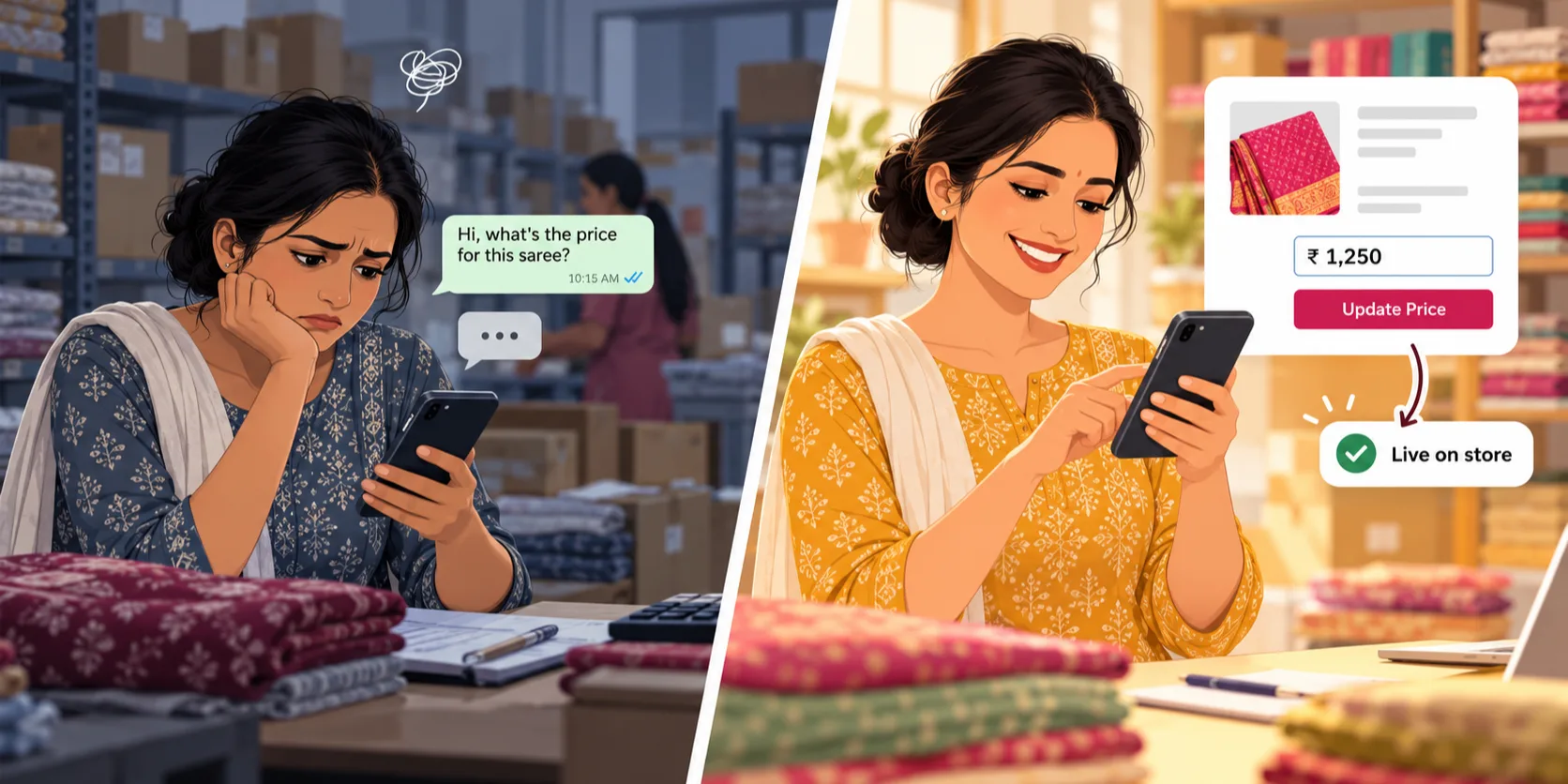
The story is common among Indian manufacturers, wholesalers and D2C brands. You pay a developer to build a website. It goes live, orders start, and then the business changes. A price moves, a product goes out of stock, a festive offer needs a banner. Each change becomes a WhatsApp message to the developer, a wait, and often an invoice.
After a year, the site shows old prices, broken menu links and products you no longer stock. Customers notice before you do. Nobody decides to let this happen. It just accumulates, one unanswered message at a time.
The real lock-in is one developer, not a platform
People worry that a platform locks them in. A custom site locks you in harder: to one person’s code, one person’s hosting account and one person’s memory of how it all works.
If that developer gets busy, raises rates or stops replying, every change stops with them. A new developer has to learn undocumented code before fixing anything, and many will quote a rebuild instead.
A platform has a support team, documentation and a product that keeps improving whether or not one person is available. QuicShop is also headless, with a GraphQL API behind it, so your catalogue, customers and orders are reachable by any tool you authorise rather than sitting in a database only one person can open.
Everyday changes should not need a developer
Most store work is routine: new products, price changes, stock updates, seasonal offers. On a platform, these are clicks in a seller console. On a custom site, each one can be a request to your developer.
On QuicShop, a seller can:
- Add or edit products, photos and descriptions from the console or the seller mobile app
- Change a price and have it live on the storefront immediately
- Update stock and let out-of-stock sizes and colours hide automatically
- Take a product off sale and put it back without asking anyone
- Rearrange the homepage in a private draft, then publish the whole change in one click
Stock accuracy is worth more than it looks. IHL Group puts the worldwide cost of out-of-stocks at US$1.2 trillion, with overstocks adding another US$572 billion; an earlier edition named poor systems (US$239 billion) and inefficient processes (US$173 billion) among the main causes. A site that shows products you cannot ship loses the sale the first time, and the customer the second.
Custom ecommerce website vs platform, feature by feature
A growing business keeps needing things it didn’t need last year. On a custom site, each one is a separate quote and a separate thing that can break. On a platform, they already exist and already know about each other.
| What you need | Custom freelancer site | Platform such as QuicShop |
|---|---|---|
| Shipping and delivery | Manual booking or custom integration | Shiprocket’s carrier network connected, plus a rider app for your own deliveries |
| GST invoices | Custom code or spreadsheets | Generated with each order, with a GSTR-1 export for your return |
| Payments | One gateway, set up once | UPI, cards, wallets, COD and Pay Later ready at checkout |
| Discounts and offers | Code change per campaign | Set up from the console |
| Staff access | One shared login, or none | Separate staff accounts with role permissions |
| Sales reports | Raw database, or none | Revenue, order and product reports in the console |
| Store design | Developer edits templates | Drag-and-drop sections, previewed as a draft, published in one click |
| Backups | Depends on the developer’s hosting | Run automatically |
The gap widens over time. A platform adds features for all its sellers. A custom site only gets what you pay for, one feature at a time.
A new look should not mean a new website
Shopping habits and design standards move every few years. On a custom site, a refresh usually means paying for a rebuild, because the design and the code were poured together and set.
A platform keeps them apart. The design is a theme sitting on top of your products and orders, so you can switch it, change banners for a festive sale, or rearrange the homepage. Your catalogue, customers and order history do not move at all.
Speed, checkout and sale-day traffic decide your sales
Three technical details quietly decide how many visitors become buyers. Platforms work on them full time; a freelancer usually builds them once.
Speed. A study commissioned by Google and run by Deloitte and fifty-five tracked the mobile sites of 37 brands in Europe and the US. A 0.1-second faster load lifted retail conversion rates by 8.4%, and shoppers spent 9.2% more. Many Indian buyers shop on phones, often on patchy connections, so every fraction of a second counts.
Checkout. Baymard Institute found that 18% of US online shoppers abandoned an order in the past quarter solely because checkout was too long or complicated. It estimates that better checkout design alone can lift conversion by about 35% on the average large ecommerce site. A platform’s checkout is tested across millions of orders.
Traffic spikes. Festive sales bring sudden traffic. Over Black Friday–Cyber Monday 2025, Shopify’s systems handled 489 million requests per minute while sales peaked at US$5.1 million per minute. A store on a single small server can slow down or go offline at exactly the moment demand is highest. QuicShop storefronts are server-rendered with three layers of caching, on managed infrastructure sized for these peaks rather than one box someone provisioned a year ago.
Security and data protection are now your legal duty
An online store holds customer names, phone numbers and addresses. Keeping that data safe means constant software updates, and a custom site depends on someone remembering to do them.
Many freelancer stores run on WordPress with plugins, and that stack has a bad year behind it. In 2025, researchers found 11,334 new vulnerabilities in the WordPress ecosystem, up 42% from 2024, and 91% were in plugins. Close to half had no fix available when they were disclosed.
India’s law has also caught up. The Digital Personal Data Protection (DPDP) Rules were notified on 2025-11-14. The main duties on consent, security and breach notification apply from 2027-05-14. Failing to keep reasonable security safeguards can draw a penalty of up to ₹250 crore (₹2,50,00,00,000).
On a platform, security patches, encrypted connections and monitoring are handled for every store at once. You still own your customer relationships, but you are not running a server alone. QuicShop’s own approach is set out on our DPDP compliance page.
The fair objections, answered
Four objections come up every time. Three of them are weaker than they sound. One is right.
“Platform fees add up.” They do, and ours are published so you can check the number. Put it against the full cost of a custom site: hosting, SSL renewal, security updates, backups, and a developer bill for every change. Then add the sales lost while a change waits. The full arithmetic is in what an online store really costs in India.
“I’ll be locked into the platform.” Fair, and worth asking of everyone, us included: how do I get my data out? QuicShop is headless with a documented GraphQL API, so your products, customers and orders are reachable programmatically. With a custom site, your data is usually only as portable as your developer feels like being.
“I want a unique design.” Themes and sections are editable. QuicShop is also headless, which means a custom front end can be built on top of it while the platform runs products, stock, orders and payments underneath.
“My business has workflows no platform supports.” This is the honest one, and sometimes it’s true. Even then, you rarely need to custom-build the whole store. Keep the unusual part custom, connect it to the platform through the API, and let the routine work stay routine. If you’re still weighing which platform, we compared the five worth considering in India.
A quick check for your current website
If you answer “no” to two or more of these, your store is costing you more than it should:
- Can I change a price or add a product myself, today?
- Do out-of-stock products hide on their own?
- Can I see and manage orders from my phone?
- Do I know who applies security updates, and when they last did?
- Will my site stay fast during a festive sale?
- Can my staff log in with their own access?
- Can I see which products sell best without opening a database?
- Could another developer take over tomorrow without a rebuild?
Try it with your own catalogue
QuicShop gives Indian manufacturers, wholesalers and D2C brands a storefront, a seller console, and seller and rider mobile apps. The point of all of it is that you run the store, not your developer’s calendar.
Book a free demo and we’ll show you how your current catalogue would look and work on QuicShop. If you’d rather just see how the setup goes, launch your store in 60 minutes walks through it step by step.
Sources
- Milliseconds Make Millions — Google and Deloitte, published on web.dev
- Cart abandonment rate statistics — Baymard Institute
- Fixing Inventory Distortion — IHL Group
- Inventory distortion causes — Chain Store Age
- Black Friday–Cyber Monday 2025 results — Shopify investor release
- State of WordPress Security in 2026 — Patchstack
- Plugin vulnerabilities without fixes at disclosure — jorijn.com
- DPDP Rules 2025 notified — Press Information Bureau
- DPDP rollout phases — Anantam IAS
Frequently asked
Is a custom ecommerce website cheaper than a platform?
On launch day, usually yes. Over a year, usually not. The custom quote covers the build; it doesn't cover hosting, SSL renewal, security updates, backups, or the developer's bill for every price change and festive banner after that. Add the sales you lose while a change sits in a WhatsApp queue, and the arithmetic turns.
Doesn't a platform lock me in more than custom code?
A custom site locks you into one person's code, one person's hosting account and one person's memory of how it works. A platform is at least a documented product with a support team. Ask either one the same question: how do I get my catalogue, customers and orders out? QuicShop is headless with a GraphQL API, so your data is reachable by any tool you authorise.
Can I still get a unique design on a platform?
Yes. Themes and sections are editable, and QuicShop is headless, so a custom front end can be built on top while the platform runs products, stock, orders and payments underneath. You get the design you want without rebuilding the commerce engine behind it.
What happens to my site if my developer stops replying?
Everything stops with them. A new developer has to read undocumented code before fixing anything, and many will quote a rebuild rather than take it over. For a lot of sellers the trigger for switching isn't price at all, it's the week a change became impossible.
Does a custom site handle GST invoicing and DPDP compliance?
Only if someone built and maintains it. GST invoices on a custom site are usually custom code or a spreadsheet, and security patching depends on someone remembering. The DPDP Rules were notified on 2025-11-14 with the main duties applying from 2027-05-14, and failing to keep reasonable security safeguards can draw a penalty of up to ₹250 crore (₹2,50,00,00,000).
See QuicShop set up for your store
GST, UPI, WhatsApp and shipping built in — from ₹2,999/month. We onboard every seller personally.