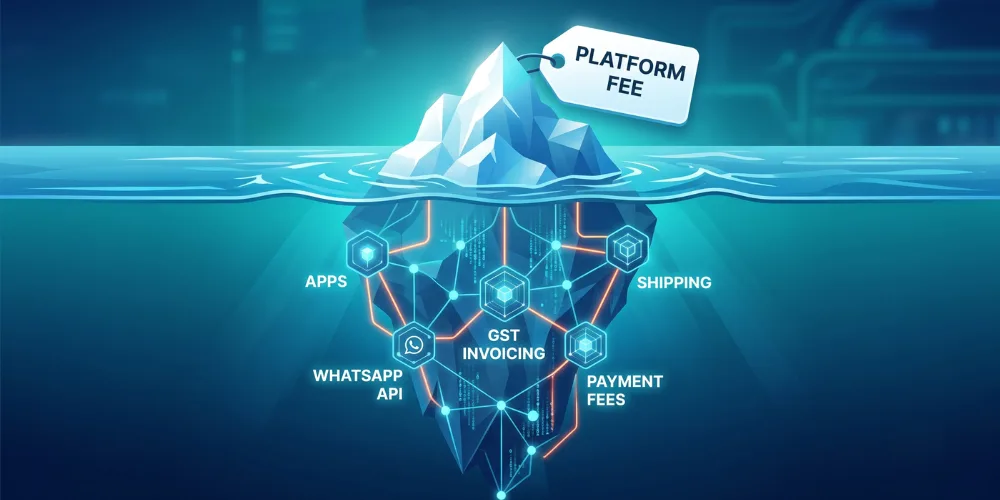
Most people pick an ecommerce platform by comparing two numbers on two pricing pages. Those numbers are easy to compare because they’re the only costs that hold still.
Everything else moves. It moves when you grow, when an app changes its pricing, when your order volume crosses a threshold, when you add WhatsApp, when you start selling wholesale, or when an integration breaks on a Saturday. None of it is visible on day one. All of it is waiting.
The short answer
Running a working online store in India costs roughly ₹4,500/month at the lean end — one platform with the India stack included — and ₹25,000+/month for a multi-app setup assembled from parts. Subscriptions start as low as ₹1,994/month, but most of your monthly spend lands somewhere else: third-party apps (WhatsApp, GST billing), payment processing around 2%, shipping, and returns.
The bill you’re shown, and the bill you get
On day one, a store costs the plan price. You get a storefront, a checkout, and enough machinery to take an order.
Then you make it work for your actual business. GST invoicing. WhatsApp updates. Shipping. SMS. Inventory tools. Bundles. Wholesale pricing. Returns. Analytics.
None of those decisions is wrong on its own. The problem is what they add up to: a platform invoice, several app subscriptions, a messaging provider, a shipping account and a payment gateway — each with its own pricing, renewal date and support queue.
Here’s a realistic monthly budget for a scaling D2C brand in India:
| Cost bucket | What it covers | Realistic monthly cost |
|---|---|---|
| Domain & hosting | .in or .com domain + cloud hosting | ₹100 – ₹1,500 |
| Core platform | Storefront engine & checkout | ₹2,500 – ₹7,500 |
| The India layer | GST billing, WhatsApp tool, COD verification, courier connector | ₹0 if native, or ₹4,500 – ₹12,000 via paid apps |
| Payment gateway | Razorpay / Cashfree / PhonePe | ~2% per transaction + 18% GST |
| Platform transaction fee | Charged by some platforms when you don’t use their own gateway | ₹0, or 0.5% – 2.0% per transaction |
| Customer messaging | Meta’s WhatsApp conversation charges | ₹0.80 – ₹1.20 per utility/marketing message |
At that point the number on the pricing page isn’t the number you budget for. That’s the first thing most platform comparisons miss: the platform price and the cost of running the store are two different things.
The costs that arrive on their own
Most supporting tools are priced by usage — orders, messages, customers, storage.
That’s reasonable commercially. It also means the tool you evaluated at 40 orders a month isn’t the tool you’re paying for at 400. You didn’t choose something more expensive; your business grew into the next tier.
WhatsApp is the clearest example. There’s a provider subscription (often ₹1,500–₹4,000/month), Meta’s per-conversation charge, and — depending on the provider — a markup on top of Meta’s rate. Your cost of talking to customers goes up as you sell more, even though you changed nothing about how you talk to them.
Your platform subscription may be fixed. Your stack isn’t. And every variable part of it moves in the same direction as your success.
The ceiling you find in month nine
There’s another version of this, and it shows up when you start selling in more than one way.
You start with retail. Then a distributor asks for a different price. A reseller wants a separate catalogue. A corporate buyer wants a quotation. Someone else wants 30-day terms.
The question stops being whether your platform can show a product and take a payment. It becomes whether it can handle how you actually sell.
Shopify has native B2B features, with limits that vary by plan. Past those limits you’re into paid apps or a Shopify Plus upgrade, which starts around US$2,000 (roughly ₹1,65,000/month). The price that matters isn’t the entry price — it’s the price of the setup that contains the one capability you can’t operate without. You usually find out which one that is after you need it. (More on how this works on QuicShop: adding wholesale to your D2C store.)
The costs that never reach an invoice
Someone has to own the stack.
One platform is one system to understand. Five integrations are five systems that can change underneath you. A theme update affects an app. A sync stops. A webhook fails. An invoice doesn’t generate. An order reaches the courier with the wrong address.
At a large company somebody is paid to own those problems. In a small Indian business that person is the founder, usually at night.
It gets worse when something breaks. Instead of one support conversation you have five — platform, gateway, messaging provider, courier, app developer — and each can point at another. The outage lasts as long as the slowest handoff. When none of those systems share a source of truth, someone has to connect the dots by hand. That time is a cost. It just isn’t billed.
The full picture, side by side
The useful comparison isn’t the subscription. It’s what you have to buy, connect and manage around it. For the wider market view, see our guide to the best ecommerce platforms in India.
1. The money
The platform fee is usually the least interesting row. For a line-by-line teardown of a typical Shopify stack, read what you’d pay for Shopify apps in India.
| QuicShop | Shopify | WooCommerce | Dukaan | |
|---|---|---|---|---|
| Base platform fee | ₹2,999–₹4,999/mo | ₹1,994–₹30,164/mo | Free (open source) | Varies by plan |
| Hosting & maintenance | Included | Included | Paid hosting + developer | Included |
| Platform transaction fee | None | 0.5%–2.0% without Shopify Payments | None | None |
| Payment gateway fees | Razorpay standard (~2%) | ~2% gateway + Shopify’s fee | Gateway charges | Gateway charges |
2. The India layer
A platform can technically sell to Indian customers without being built around how Indian businesses operate.
| QuicShop | Shopify | WooCommerce | |
|---|---|---|---|
| GST invoicing with HSN | Included | Paid app (₹800–₹2,500/mo) | Paid plugin |
| UPI / cards / COD | Native via Razorpay | Via third-party gateway | Via gateway plugin |
| WhatsApp order updates | Included | Paid app (₹1,500+/mo) | Paid app |
| Multi-carrier shipping | Included (Shiprocket) | Paid app | Paid plugin |
3. Wholesale and B2B
This is where the economics change. Does the same catalogue and stock need to serve retail and wholesale?
| QuicShop | Shopify | Zoho Commerce | |
|---|---|---|---|
| Tiered wholesale pricing | Included | Plus or paid app | Available |
| Quotes / RFQ | Included | Paid app | Available |
| Credit accounts (payment terms) | Included | Plan-dependent | Available |
| Runs on the same catalogue & stock as retail | Yes | Yes, with plan limits | Yes |
Worth being precise here, because vendors usually aren’t: on QuicShop these are the essential B2B building blocks sitting on a D2C core — tier pricing, quotes/RFQ and credit accounts on the same catalogue, orders, inventory and GST. It’s not a second wholesale product bolted alongside your store, and wholesale buyer onboarding and verification aren’t built yet. If you need a full distributor portal today, we’re not it.
Where the alternatives genuinely make sense
No platform is right for every business.
Shopify has the broadest ecosystem here by a distance. If you need specialised apps, deep customisation, or serious international selling, that breadth is worth paying for.
WooCommerce is a different trade. You get control and customisation, and in exchange hosting, plugins, security, updates and developer support become part of your operating model. Its real entry cost isn’t the licence — it’s the person who keeps it all running.
Zoho Commerce makes sense if you already live in Zoho. When CRM, accounting and inventory are there, the integration is genuinely useful.
QuicShop is built around a different question: what if your store, billing, inventory, payments, customers, WhatsApp and wholesale pricing didn’t have to be assembled from separate pieces in the first place?
What “included” actually changes
The first saving you notice is money. The one that matters more is predictability.
When GST invoicing, inventory, customers, orders and WhatsApp messaging are part of the platform, you’re not managing six vendors. One platform, one renewal, one login, one place to look when something’s wrong.
More usefully, the pieces already know about each other. An order moves stock. Stock decides what’s sellable. The order produces a GST invoice with the right HSN code. The goal isn’t to make every third-party cost vanish — it’s to cut the number of moving parts between “customer placed an order” and “the business knows exactly what happened.”
Where it isn’t free, and we should say so
Three costs don’t disappear on QuicShop:
- Payment processing. Razorpay charges its standard rate, typically around 2%. Settlements go straight to you.
- Shipping. Shiprocket and your couriers charge to move parcels. We integrate with them; we don’t make delivery free.
- WhatsApp messaging. Meta charges per conversation. Those charges stay.
What QuicShop doesn’t do is stack another software subscription on top of those for capabilities that should have been in the product — and we don’t take a percentage of your sales as a platform fee.
So what does a store really cost?
Platform + apps + integrations + payment fees + messaging + shipping + maintenance + your time.
At a small scale the gap between one platform and a stack of apps looks like rounding. For a growing brand it becomes a recurring operating cost that scales with you. And for a founder running the business with two other people, the expensive part is the hours spent making disconnected systems behave like one.
So when you compare platforms, don’t only ask what the monthly plan costs. Ask what you’ll be paying for, connecting and managing when the store is doing ten times today’s volume. That’s the number worth comparing.
See QuicShop’s plans — ₹2,999/month, GST, UPI, WhatsApp and shipping included, no per-order platform fee.
Frequently asked
What are the hidden costs of running an online store in India?
Beyond the platform fee, Indian stores regularly pay for GST invoicing, a WhatsApp messaging tool, a shipping aggregator, payment processing (typically around 2%), assorted apps, and the technical maintenance that keeps them talking to each other.
Why do ecommerce costs increase over time?
Most supporting apps are priced by usage or in tiers. The bill climbs when your order volume, message volume or customer count crosses a threshold — so a stack that was cheap at 50 orders a month can need a very different budget at 1,000.
Does Shopify charge a transaction fee in India?
Yes. Shopify Payments isn't available for domestic processing in India, so you use a third-party gateway like Razorpay or Cashfree — and Shopify adds its own transaction fee (roughly 0.5%–2.0% depending on plan) on top of what the gateway charges.
What is the real cost of managing multiple ecommerce apps?
Subscriptions are only part of it. You also carry integrations, theme updates that break apps, support handoffs between vendors, and reconciling data between systems. For a small team that time is a real operating cost — it just never appears on an invoice.
What does QuicShop cost, and what still costs extra?
QuicShop is ₹2,999–₹4,999/month with no platform transaction fee. Payment processing (Razorpay, typically around 2%), courier charges (Shiprocket) and Meta's WhatsApp conversation charges are still billed by those providers — we don't add a software subscription on top of them.
See QuicShop set up for your store
GST, UPI, WhatsApp and shipping built in — from ₹2,999/month. We onboard every seller personally.