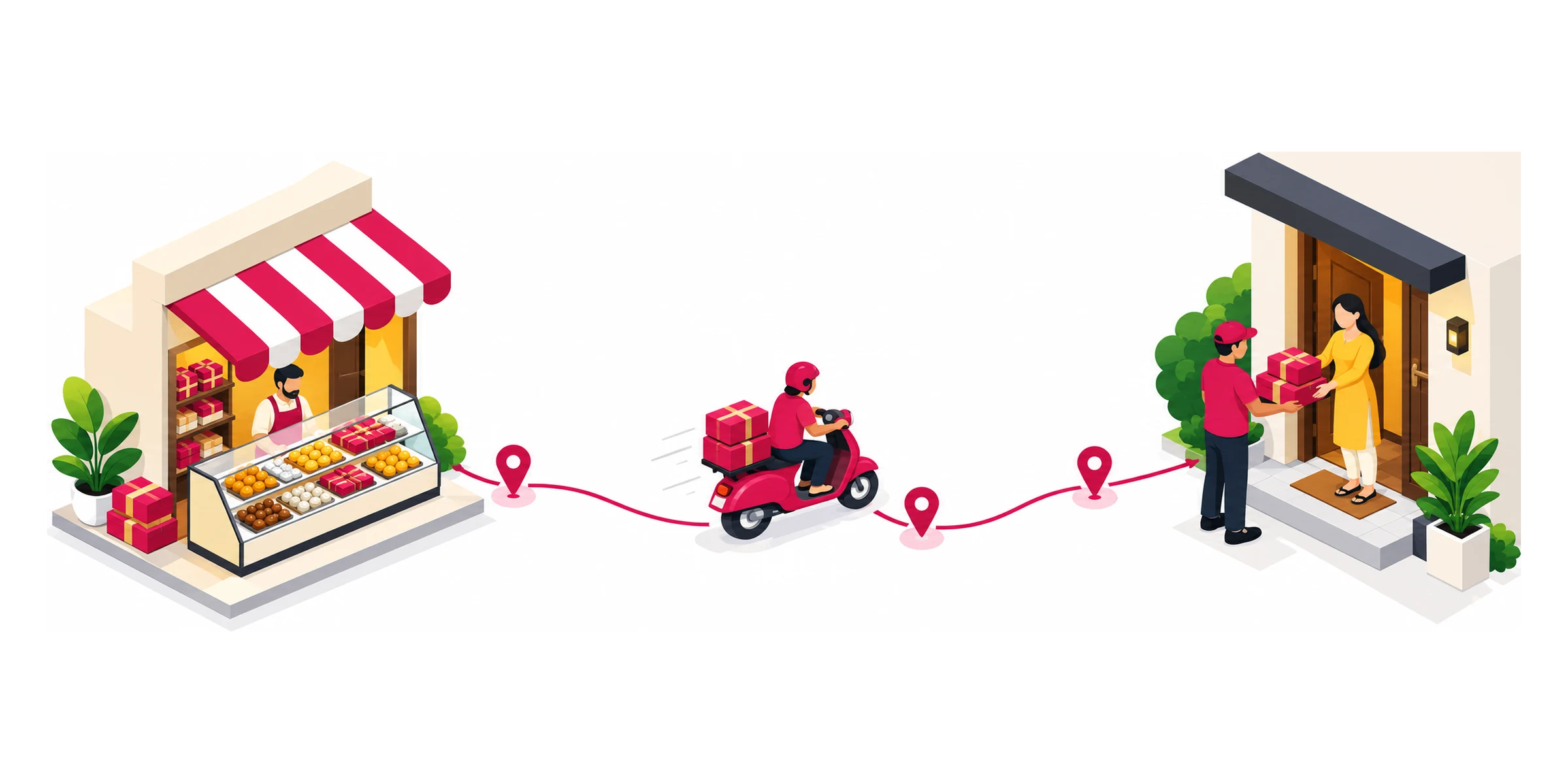
A customer orders fifty boxes of sweets for a pooja. They live three kilometres away. You hand it to an aggregator and pay ₹60 to move a box across a neighbourhood you’ve been trading in for forty years — while two of your own staff are standing behind the counter.
That’s the trade a lot of Indian shops are making without ever having sat down and priced it. So here’s the price.
The maths, at three volumes
A courier or aggregator runs ₹40–₹80 for a local drop. Sending someone who already works for you costs roughly ₹15–₹25 once you count fuel and the time they’re away from the shop.
At ₹60 against ₹20:
| Deliveries per day | Per month | Courier | Your own rider | Difference |
|---|---|---|---|---|
| 10 | 260 | ₹15,600 | ₹5,200 | ₹10,400 |
| 20 | 520 | ₹31,200 | ₹10,400 | ₹20,800 |
| 30 | 780 | ₹46,800 | ₹15,600 | ₹31,200 |
For a shop doing twenty local drops a day, that’s roughly two lakh eighty thousand rupees a year going to someone else to do something your own people could do on the way home.
The number that changes the answer
Everything above assumes staff you already pay. That’s the honest condition, and it’s where most of these comparisons quietly cheat.
If you’d be hiring someone specifically to deliver, the maths is different, because the cost stops being per-drop and becomes a salary that arrives whether you use it or not:
| Rider salary | Break-even | Roughly |
|---|---|---|
| ₹14,000/month | 350 drops/month | 14 a day |
| ₹18,000/month | 450 drops/month | 18 a day |
| ₹22,000/month | 550 drops/month | 22 a day |
Below that, the courier is cheaper and you should keep using it. There’s no shame in the answer being no.
Where own delivery clearly wins
Anything perishable or fragile. Sweets, cakes, flowers, prepared food. The aggregator’s rider has four other drops and no reason to care whether your barfi arrives in one piece.
Festival weeks. Diwali and wedding season are when your order volume peaks — and when aggregator surge pricing peaks with it. It’s the worst possible week to be a price-taker on delivery.
Same-day promises. Courier SLAs are next-day at best for most local pincodes. If you’re promising delivery this evening, you need to control the vehicle.
Anywhere the experience is the product. A 75-year-old shop whose reputation is built on how customers are treated has a reason not to outsource the only moment of physical contact in an online order.
Where it doesn’t
Outside your radius. Beyond eight or ten kilometres, one rider’s round trip eats a slot they could have spent on three closer drops.
Low, unpredictable volume. Five drops a day doesn’t justify the coordination overhead, let alone a hire.
Anything you’re already shipping nationally. This is not a replacement for Shiprocket. It’s a different job.
The right setup for most shops is both: own riders inside the radius, couriers everywhere else, chosen per order.
The part that doesn’t show up in the maths
Every table above prices a delivery as though the only thing being moved is a box.
For most shops it isn’t. The rider is the one moment in an online order where a real person from your business stands in front of a customer. That moment is either an extension of how you’ve always treated people, or it’s a stranger in a branded jacket with four other drops to finish.
Your own staffer knows things an aggregator rider can’t be told. That the flat on the second floor is an elderly couple who take a minute to reach the door. That the Sharmas order every Diwali and should be wished. That a box of sweets travels flat, not upright, and gets carried rather than swung. That if nobody answers, the neighbour on the left will take it in.
None of that is in a delivery SLA. All of it is why the customer orders from you and not from someone cheaper.
There’s a harder version of the same point. When your own rider is careless, that’s your brand too — you can’t blame a third party. But that’s also the difference: your rider can be coached tomorrow morning. An aggregator’s cannot, and the complaint still lands on your phone either way.
For a shop trading on a name built over decades, outsourcing the only physical contact in the entire order is a strange place to economise. And on the days that matter most — a pooja, a wedding, the week of Diwali — it’s often the delivery people remember, not the packaging.
What it actually takes to run
The per-drop saving is the easy part. These four are what determine whether it works:
Assignment. Someone has to decide which rider takes which order, and do it fast enough that it doesn’t become the bottleneck. On paper this is a phone call; at thirty orders a day it’s a full-time job unless the system does it.
Proof of delivery. “I delivered it” is not a record. You want an OTP the customer reads out, a photo of the handover, or a signature — something that settles a dispute three weeks later.
Cash reconciliation. COD means your rider is carrying your money. You need to know how much left the shop and how much came back, per rider, per day.
Tracking. Without it, every customer who’s waiting phones the shop — and answering those calls costs more than the delivery saved.
Get those wrong and own-fleet delivery is cheaper per drop and more expensive overall. That’s the failure mode, and it’s common.
How it works on QuicShop
Self-delivery is built in — you don’t buy a separate logistics tool for it.
Register the staff who’ll deliver as riders, each tied to the branch they work from. They sign in on their own phone with an OTP, and see only their own trips — no access to your console, your orders or your customer list.
When a local order comes in, you assign it from the order screen. The rider gets a notification, accepts, and moves the trip through pickup and en route to delivered. Your customer watches a live map from their order page, and sees the rider’s name and a masked number — never the full one, in either direction.
At the door, proof of delivery is an OTP, a photo or a signature, whichever your shop’s policy requires. COD amounts show on the trip so the rider knows what to collect. Failed deliveries get a reason recorded rather than a shrug. Return pickups run the same way in reverse, with proof of pickup.
And Shiprocket stays exactly where it was. Delivery method is a per-order choice, so the long-distance orders carry on as before.
Rider accounts are ₹299/month each and are counted separately from staff accounts — Growth includes two. The setup guide walks through it end to end.
Two things to know before you start
Live tracking needs the rider’s app open. Location is reported while the app is in the foreground. If they lock the phone, the customer’s map pauses until they open it again.
A failed delivery doesn’t raise a return automatically. If a rider marks a delivery failed and the goods come back to the shop, you create the return yourself for now.
The short version
If your customers are close, your volume is steady, and the people are already on your payroll, delivering it yourself is one of the few cost savings in retail that doesn’t require you to sell more of anything.
If you’d be hiring for it, work out your break-even first — and be willing to conclude that this year, the courier is still the right answer.
See what QuicShop costs — ₹2,999/month inclusive of GST, with self-delivery, GST, UPI, WhatsApp and courier shipping built in.
Frequently asked
Is it cheaper to deliver locally with my own staff?
Usually yes, if the people are already on your payroll. A courier costs ₹40–₹80 a drop; the marginal cost of sending your own staffer is roughly ₹15–₹25 once you count fuel and time. At 20 drops a day that's about ₹20,000 a month. If you'd be hiring someone specifically to deliver, the break-even is nearer 400–450 drops a month.
Do I have to choose between my own riders and a courier?
No, and you shouldn't. Own riders make sense inside your delivery radius; couriers make sense everywhere else. On QuicShop the delivery method is chosen per order, so both run side by side.
What do I need to run my own deliveries?
Someone to assign each order, a way for the rider to prove delivery, a way to reconcile cash, and tracking so customers stop calling to ask. Without those four, own-fleet delivery costs less per drop but more in everything else.
How do customers track an order delivered by my own rider?
Their order page shows the rider's name, a masked contact number and a live map once the rider is on the way. The rider never sees the customer's full number, and the customer never sees the rider's.
Does using my own staff actually make a difference to customers?
It's the one moment in an online order where someone from your business meets the customer in person. Your own staffer knows the regulars, knows how the product should be carried, and can be coached if something goes wrong. An aggregator's rider has four other drops and no stake in your reputation — but the complaint still reaches you.
What about cash on delivery?
The rider sees the amount to collect on the trip in their app, and collects it at the door. Reconciling that cash at the end of the day is your process, not the platform's.
See QuicShop set up for your store
GST, UPI, WhatsApp and shipping built in — from ₹2,999/month. We onboard every seller personally.